
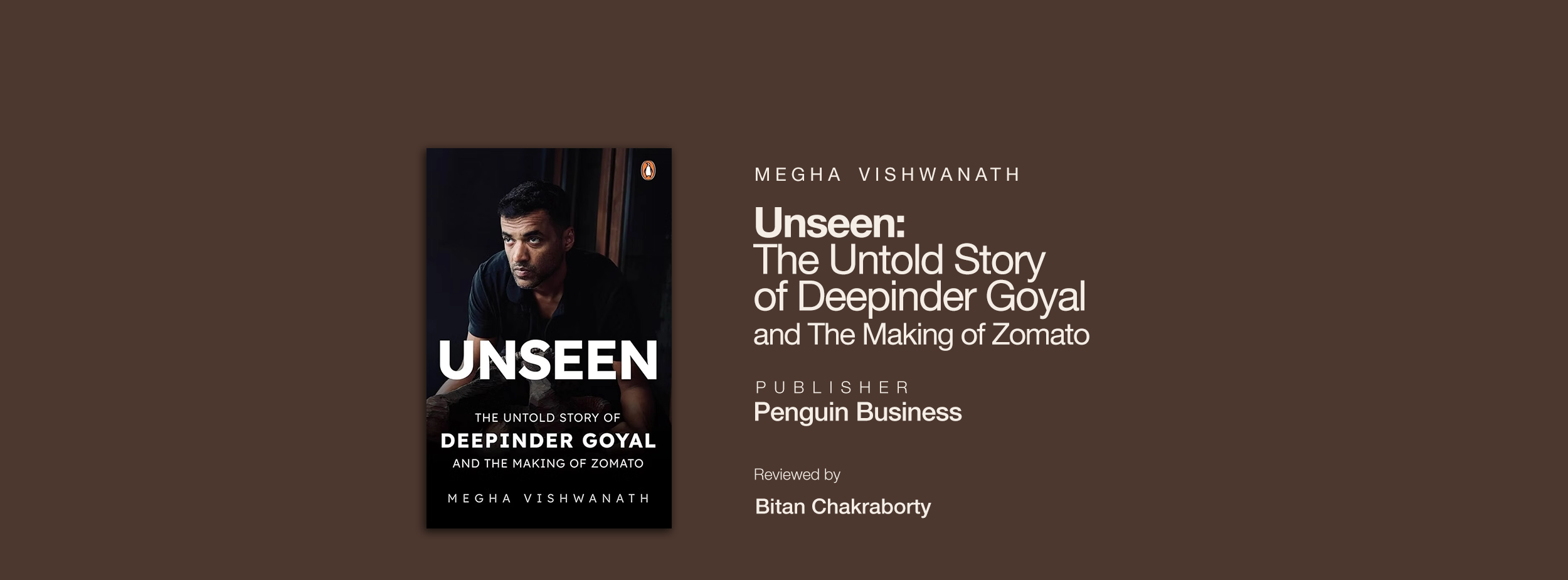

Unseen – the untold story of Deepinder Goyal and the making of Zomato by Megha Vishwanath comes across as a crossover between a business biography and a eulogy to the protagonist. Having been published by Penguin Random House under Penguin Business, one tends to believe that the intent of the book is to be considered as a business biography, or at least a business read. The style and tonality of the book however make it an apologetic candidate in this genre, swerving more into literary non-fiction.
The book opens with the publisher’s note which clarifies “This is not a biography. Nor is it a linear march of a man from childhood to success. Unseen is the anatomy of a founder…”. And the book ends with the author’s note mentioning “I began this book thinking it was about a company. It turned out to be about a person.”
It is between these two caveats, the book plays out the story of Deepinder and Zomato as it traverses through the initial hustling days of a bunch of IIT Delhi graduates to detailed business operations to sharp financial deals while also being garnished with melodramatic scenes of flickering tubelight lit rooms and striving parents of Deepinder. An overt attempt to portray his childhood as one of economic and social struggle, despite the fact that his double income earning teacher parents in the end decade of 1990s could afford a Maruti car, and therefore were economically decently well off as a middle class family in Punjab, a state having amongst the highest GDP in the country. This penchant of Megha for melodrama, is most likely to put off an avid business reader, but comes across again when narrating Deepinder’s courting of Kanchan, his to-be wife at IIT Delhi, and his teenage romantic resolves portrayed as an early indication of his future business acumen.
Quarter ending April – June 2023, Zomato reported a profit of INR 2Cr. Its first ever profit. Breaking even for the first time in 17 years since its launch in 2006. Not an enviable economics of business to emulate. Also as explained by Deepinder via his Time vs Confidence graph to his team, towards the book’s end.
The first peaking of business performance on this Time vs Confidence graph labelled by Deepinder as “The Maverick Rise” is actually quite avoidable for any business if one were to place customer and market first instead of the product, a fundamental business strategy, which traditional businesses always adhere to.
The book illustrates many honest and introspective learnings by Deepinder and words of wisdom from his mentor, Sanjeev Bhikchandani of Info Edge like – the error of focusing only on topline growth, misleading picture of bank balance when booked expenses are not accounted and many more. Sanjeev’s mail to Zomato just before their IPO detailing the nuances and after effects of an IPO from the point of view of bankers, investors and media comprises pearls of wisdom that can work as a cheat sheet for startup founders.
All of these could wonderfully qualify this biography by Megha Vishwanath to be suitably positioned as a ‘Handbook of the pitfalls to avoid by Startup Entrepreneurs”. Megha however chose to portray Deepinder as the knight-in-shining-armour winning the business war, where in reality there was no need for a war, if the initial rampant lavish cash burnout, unplanned expenses and reckless business decisions did not exist. Business decisions that were later acknowledged by Deepinder to be erroneous.
This is not to deny that Zomato was indeed a great business idea from the very beginning, since it was able to put its finger very correctly on an unmet consumer need. Something most Indian startups fail to identify. This ability of a business to offer solution for an unmet consumer need is what makes businesses succeed, whether they are formatted as a startup or as a traditional business.
Megha insists the book is about Zomato post its IPO success. She claims that’s the USP of the book. However, of the 268 pages in the book, upto page 213 it is a narration of events prior to the IPO. Only 63 pages at the end (pages 214 – 276) are post IPO, primarily about the acquisition of Blinkit. Positioning the book on ‘Post IPO’ again focusses on the mythical high point of today’s startups, whereas the purpose of Deepinder and Sanjeev Bhikchandani, as evident in the book, has been to debunk the myths the starry-eyed-ivory-tower-sitting startup owners remain disillusioned about.
In addition to the pitfalls to be avoided the other big takeaway from this book is the management style of Deepinder. What emerges as his strongest skill, is his ability to drive the business as a separate individual entity. People, roles, functions, job titles kept changing every time as required, to ensure Zomato the business, survived and thrived. A fact further proven by Deepinder’s most recent decision in January 2026 to step aside from being the CEO and putting Albinder in charge of Zomato.
This is also the reason why Deepinder could again scale up from “No Man’s Land” to “Greatness” after initially sliding down from the “Maverick” peak as illustrated in his own Time Vs Confidence Graph. Suitably summed up by Megha when she says “At Zomato leadership is leased, never owned” – based on Deepinder’s concept of Rotational Leadership.
It is said that history reflects the point of view and biases of the person who wrote it. Same applies for business biographies, as it is a documentation of business history and individual heroics. The fact that Megha was hired at Zomato to enable her observe from the trenches and write, does not really help the cause, from a reader’s perspective. And to note that the Marketing Head Megha is nowhere to be seen in action in the story of Zomato!
For instance, when one reads a Cold Steel, portraying Lakshmi Niwas Mittal in the backdrop of events leading up to the acquisition of Arcelor, the authors Tim Bouquet and Byron Ousey, do a commendable job by taking the stance of being ‘a fly on the wall’, and just documenting the chain of events, as they unfolded, without letting their judgement style the narrative.
In Unseen however, at times Megha’s narration seems to depict the style of an author of fiction, who indulgently reveals the various facets of her protagonist and other characters, rather than documenting the way a business writer or biographer would do.
Of course, there is lot to learn for the readers of UNSEEN from the manner in which Deepinder ultimately pulled Zomato into all sunshine, glory and profit, plus the acquisition and success of Blinkit (along with Albinder and Akshant), which is definitely a testament to his belief ‘Only the Paranoid Survive’, a phrase used by Andrew Grove the Chairman of Intel Corporation as the title of his semi biographical book.
In all, Unseen also leaves us with a very poignant question relevant to today’s startup world. Business Growth is achieved by Burning Cash to sustain business. Life Growth is achieved by Burning Health and Relationships to sustain life.
Is this success wholesome?
Kanchan and Deepinder of the IIT Delhi days knows best!