


Bunohaansh
The owl's ashen wings fly towards the dizzying heights of the stars — Leaving behind the marshy lands and the low lying bog. In answer to the moon's bewitching lure, the wild ducks spread their restless wings in a lyrical flight.
Original poem: Jibonananda Das | Translation: Koel Mallick
The Wild Ducks
The owl's ashen wings fly towards the
dizzying heights of the stars —
Leaving behind the marshy lands and
the low lying bog
In answer to the moon's bewitching lure
The wild ducks spread their restless wings- in a lyrical flight
The speeding flutter of their wings
heard by me
Sweeping the sky
Once - twice - thrice - four times -
Countless -
Infinite -
The sound of the frenzied beating of their wings
At night's liminal edge
Like the resounding drone
Of the moving engine; the birds soaring
Racing higher - higher still.
Yet what remains is a
faraway star in its vast expansive sky
A whiff of fleshly scent
Of the wild ducks
And one or two birds of spirited fantasy and imagination.
Memories awaken of yonder -
the time-swept face of the
village girl Arunima Sanyal;
May they fly and soar in the
streaming moonlight of
a wintry bareness in a quiet flight.
The ducks of imagination -
when all sounds all hues of
the earth have been silenced
May they still fly higher and higher
in the heart's cage
Where soundlessly moonlight still sweeps in.
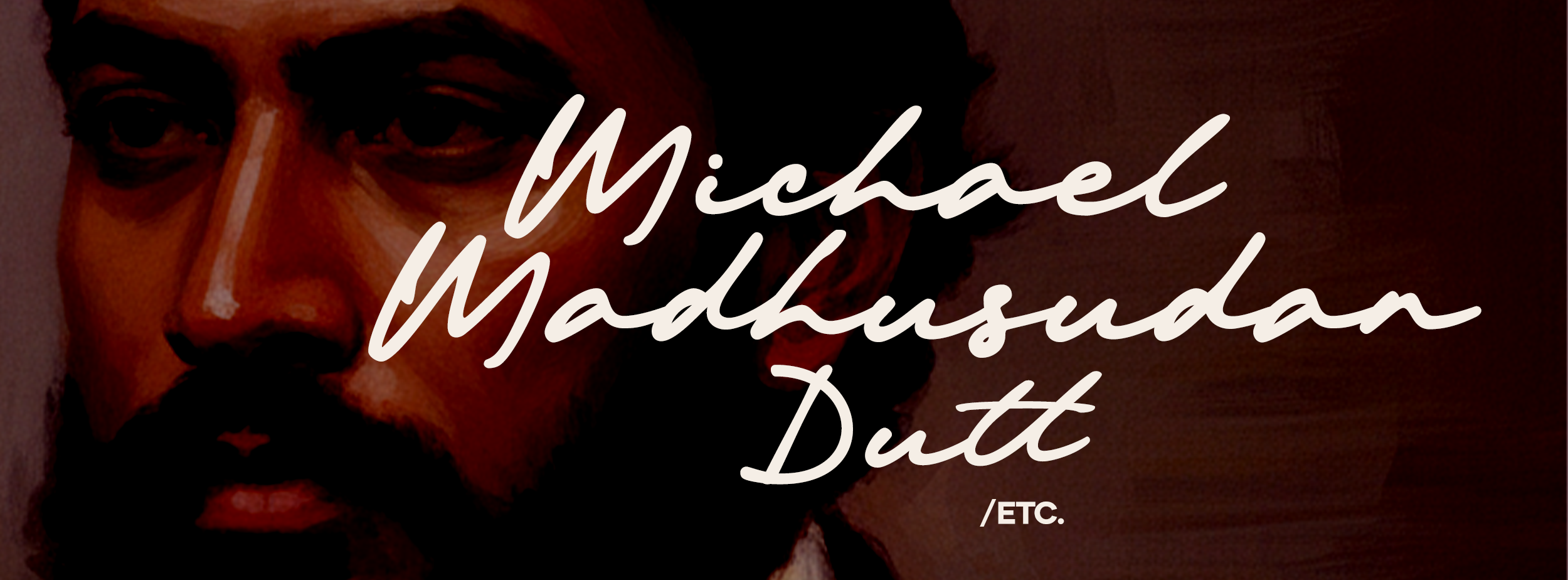
the bengal renaissance and michael madhusudan dutt
Michael Madhusudan Dutt was a literary comet who blazed across the Bengali sky, transforming the landscape of Bangla literature in just 14 years. A rebel and visionary, he shattered ancient poetic traditions, introducing blank verse, sonnets, and European-styled drama to Bengali. From 'Meghnad Bodh Kabya' to his poignant apology poems, discover how this audacious iconoclast became the architect of modern Bangla literature—a revolutionary whose legacy inspired giants from Tagore to Vidyasagar.
Michael Madhusudan Dutt, born in 1824, was a literary comet who blazed across the Bengali sky through his most influential period spanning just 14 years (1858–1873). Imagine a rebel, a visionary, a man consumed by ambition – that was Dutt. He began as a die-hard Anglophile, chasing English literary glory in Madras, where he built a life, and two marriages. But fate, in the form of his estranged father's death, yanked him back to Kolkata, igniting a fiery reconnection with his neglected mother tongue.
The arrival of Michael Madhusudan Dutt on the Bangla literary scene was not a gradual return, but a seismic event. An iconoclast by nature, Dutt effectively detonated the established, staid traditions of Bangla literature. He shattered the ancient molds of poetic and dramatic expression, forging entirely new forms and themes across poetry, epics, and plays. Consider his “Meghnad Bodh Kabya,” a towering epic that single-handedly redefined the genre. Or take “Sharmishta,” the first original Bangla drama, a European-styled theatrical earthquake that not only shook the dominance of Sanskrit verse but also dismissed the prevalent rustic Mangal Kavyas. Demonstrating the untapped potential of the Bangla language for sophistication, he even dared to craft sonnets in it, revealing its capacity for both elegance and profound depth. Furthermore, Dutt unleashed blank verse, a revolutionary, unrhymed torrent that swept through Bangla poetry, inspiring generations of writers and resonating even in Hindi and other literary traditions. His ceaseless experimentation with diction and verse forms led to the introduction of Amitraksar (his innovative form of blank verse characterized by run-on lines and varied caesuras), both Petrarchan and Shakespearean sonnets in Bengali, and numerous original lyric stanzas. Interestingly, it was not Shakespeare or Milton who served as Madhusudan’s guiding star, but Lord Byron. Indeed, the lives of Byron and Dutt bear a striking resemblance, their personalities marked by a shared “audacity” – a quality reminiscent of Danton, the French revolutionary, and his famous call: “l’audace, encore l’audace, toujours l’audace!” (audacity, more audacity, and ever more audacity).
Dutt’s heroines were far from the traditional image of meekness; they were fierce and independent, particularly evident in his reinterpretations of the Ramayana. His sharp satires, “Ekei ki boley shobbhota” and “Buro Shalik er Ghar e Ron,” acted as barbed arrows aimed directly at social hypocrisy and moral decay. Yet, amidst these groundbreaking achievements, a poignant regret emerged. In his poems “Bongobhumir proti” and “Bangobhasha,” he offered a heartfelt apology, like a prodigal son, for his past perceived neglect of his literary homeland. Though his life, a tumultuous journey of brilliance and adversity, ended prematurely, his legacy remains unshakable. From luminaries like Iswarchandra Vidyasagar and Rabindranath Tagore to Nirad C. Chaudhuri and Sir Ashutosh Mukherjee, the giants of Bengali culture recognized him as a true revolutionary. Michael Madhusudan Dutt was the architect of modern Bangla literature, a bold iconoclast who dared to rewrite the fundamental rules, thereby indelibly changing the landscape of Indian literature itself.
Author’s translation of Dutt’s iconic poem Rekho Ma Dashore Money:
A Plea to Mother Bengal
“My native Land, Good Night!” – Byron
O Mother, at your feet I plead,
If in my dream’s pursuit life impede,
Let not your heart's lotus stream,
Flow barren of my memory's gleam.
If, on a foreign, distant shore,
My star falls, my life is o'er,
No grievance holds this mortal frame,
For death's embrace, all must reclaim.
Can the life’s river ever stagnantly stay?
Yet, if within your heart I dwell,
No fear of death's dark, fatal spell.
As in nectar's pool, no fly can get away
Blessed are those, the world reveres,
Whose deeds endure through passing years.
What worth do I have for such grace to claim?
From you, O birthland, my sacred dame!
If your mercy sees my faults transcend,
And weigh goodness, blessing lend
Grant me the boon of lasting name,
To bloom in memory's gentle flame.
Like lotus-scent in slumber deep,
Be it autumn or spring.