
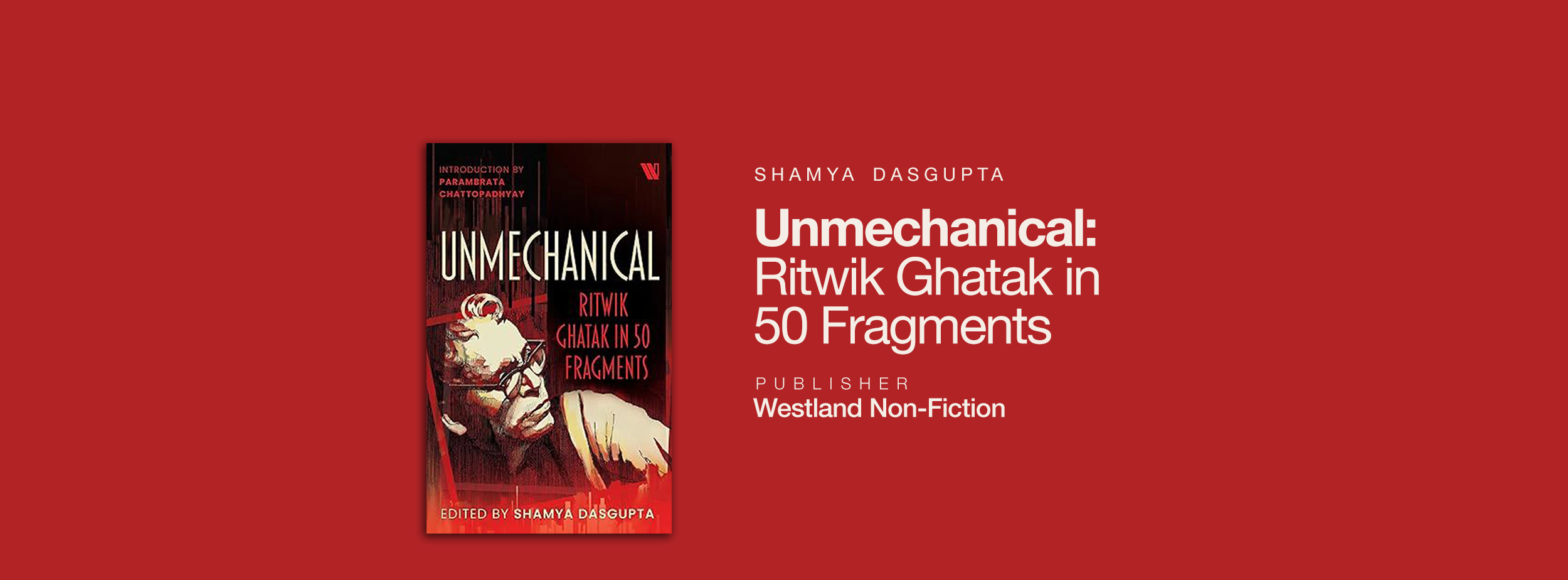

There could not have been a better way to kick off the Ghatak Centenary.
And there was no better way to know Ritwik, the filmmaker—or Bhoba, the person—without going through the 50 essays painstakingly collected by the editor, Shamya Dasgupta.
Even if you are not a film buff or a Ritwik person, the book is still a Collector’s Item.
I may be sounding a little overwhelmed, but I have my reasons. My formative years were spent on the streets of Kolkata, and in the late-sixties and early-seventies when you had got out of school and started soaking in the depths of Kolkata culture, started leaning towards the Left, participating in Group Theatre, hanging around Mrinal Sen shooting Calcutta 71, you were living in the best time of your life.
In the film world, we were in awe of Ray; Sen was the always-accessible Mrinal da; and yet the man who was being venerated as the cult figure was Ritwik Ghatak. Somewhere he was the singular face of anti-establishment, not just politically but also someone who cared a damn for social norms. To many of us, he was the “hero.”
Actually, he was an enigma.
Hence, when I started going through Shamya’s book, it was like all the pieces started coming together. The fragmented stories we used to hear about him—how he shot a particular scene, the impact of some of the dialogues in his films, like “Raat kota hoilo?” or “Dada, ami banchtey chai!” (though my favourite was Jahar Roy delivering “Gagarin, Sir, Gagarin…”)—and tales about his crazy lifestyle made us feel closer to the rebel within the man.
Barring Bari Thekey Paliye, I had seen his major works with my master and mentor, Jagannath Guha, who himself was a part of Ghatak’s circle, and in time, I was close to some members of Ghatak’s family and, in particular, Bappa da. All this meant better appreciation of his films and the individual.
In the anthology, all this comes alive, and more. And what a collection! From an essay by his twin sister, his family members, and then on to a piece by Safdar Hashmi (which was a surprise, really), his contemporaries, and finally his star-studded students like Kumar Shahani and Adoor Gopalkrishnan makes this anthology a wholesome volume. It also has many pieces by Ritwik on Ritwik and interviews. To set the tone, the introduction is by actor-director Parambrata Chatterjee, a grandnephew of Ritwik.
Who was Ritwik? I think Shamya has summed it up very well in the Preface:
Ghatak was and remains as much about the mystique and the lores around him—irreverent and eccentric, alcoholic and irresponsible, wastrel and genius—as about his filmmaking. Not many people watched his films when they were made; sometimes the world conspired to make sure they were not watched, and they made little or no money. This is still true when many of these films are regulars on the festival circuit, are being restored by institutions in the West, and are available right there on YouTube and elsewhere, easy to watch. But Ghatak isn’t easy to watch. Maybe that’s why the cult around him has kept growing, helped no doubt by the element of mystery around the man. Who was he? What did he do? What was his cinema about? What did he believe it could do? Why did he do what he did?
How the editor collated the essays, had many of them translated, annotated, and placed them perfectly can only be left to the imagination. Being a part of Ritwik’s family must have helped, but that association can only take you this far and then you are on your own. The amount of homework he has done and the lengths he must have gone to put the act together will be evident to anyone who has the book in hand. In fact, I would like you to ask him that over a chat when we have one.
Just before he was admitted to the hospital, Ritwik was staying with a very close friend of mine near the Ranikuthi area of Kolkata. Samchak was returning home one evening when he found Ritwik in the neighbourhood and dragged him to his room. The next day he came and met me and told me how he was attending to the legend and that I should come over and have a chat with him. Before I could make it, he was shifted to the hospital, and in his death, the story of Ritwik actually began.
He was unmechanical, and this book will help us make him be understood better—or at the very least, get to know him better.