
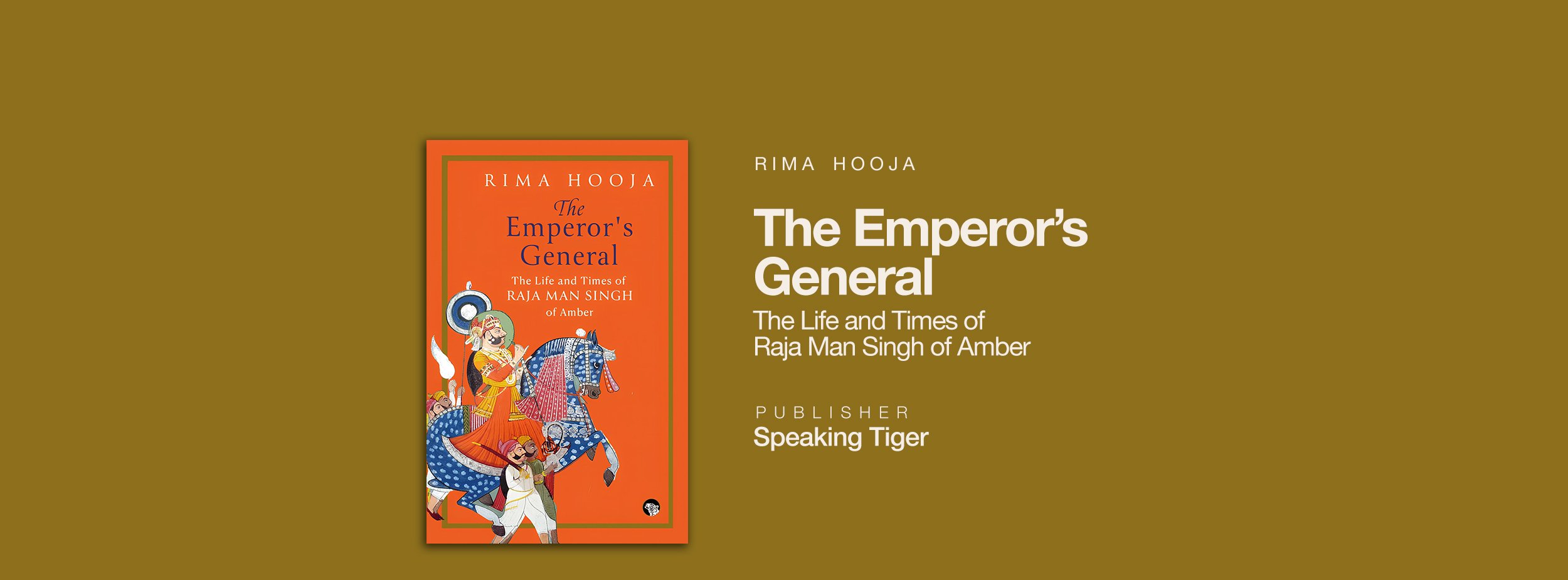

I first read about Man Singh in Class VIII. We had just started reading about the Mughals, and with the chapter on Akbar came a man called Man Singh of Amber. At that young age, the name read funny. All of us backbenchers read it as “Man” Singh, instead of the more appropriate “Maan” Singh. Of course, a cursory review of the Mughal Era in the 8th grade hardly covers anything more than major battles and key milestones of the major rulers. Man Singh remained merely a footnote.
Which is why, reading Dr Rima Hooja’s The Emperor’s General: The Life and Times of Raja Man Singh of Amber was a welcome glimpse into the world of one of Akbar’s most trusted and decorated generals.
It isn’t easy being Man Singh. Introduced to the Mughal court as a part of Amber’s matrimonial alliance with the Mughal emperor, Akbar, Man Singh evolved into a trusted general, a close member of Akbar’s special entourage, and a bane to the enemies of the Mughal court. And when it came to the latter, it has also earned him the tag of traitor to the Rajput cause.
But like I said before — being Man Singh was not easy. It was a complicated trajectory, a life that kept him away from Amber from childhood, made him arrive at the Mughal court of Akbar in Agra when he was fresh into his teens, and kept him further away from his state on his various military conquests around the length and breadth of the Mughal Empire. From Kabul in Afghanistan in the north-west, to Bengal and Orissa on the eastern front.
An able General, Man Singh’s greatest test of conscience came in leading the charge against the Rajput maverick, Maharana Pratap, at the Battle of Haldighati. Not only was the fate of Mughal dominance in Rajputana on the line here, it was also a test of Man Singh’s loyalty to his empire vs his people.
Man Singh’s life, consequently, remained a test of loyalties, a test of showing his prowess, of being an Emperor within the folds of an even greater one. Make no mistake about it, being Akbar’s chosen general took nothing away from the fact that he was a King in his own right. His entire life is not celebrated only for his military victories but also because of his sharp governance, his patronage of the arts, building and working on forts, and most importantly, leaving a lasting legacy of his historic rule.
Dr Hooja’s book went a long way in satisfying my curiosity about the man, the myth, the legacy of one of the country’s most illustrious figures. For all my historical understanding, I knew that the Battle of Haldighati was fought between the Mughals and the Rajputs; little did I know how important Raja Man Singh was in that famous battle of two titans. Little did I know that Raja Man Singh was much more than a part of Amber’s offering to the Mughal crown. I have no shame in admitting that I knew nothing about Man Singh going into the book. And now I am completely satiated.
The book has been written lucidly while firmly establishing the entire genealogy of the Kachhwaha rulers of Amber, while also running a parallel re-telling of the Mughals in India. The book follows the current trend of focusing on the supporting characters of history and this trend is a welcome change from following the many attempts at retelling the same old major stories from the annals of history. The fact that it took me this long to find out more about Raja Man Singh is telling. But the fact that I did get to know more about him with this book, that speaks even more about the times we live in.
Dr Hooja needs to do more. Uncover more tales from history, of characters mentioned in passing before, of characters that need to be known better — of history that needs to be said better.
I would be remiss if I did not make special mention of the publishers, Speaking Tiger. Not only have they been commissioning good books, interesting books for the longest time now, the books they produce are turning out to be a must-have for book connoisseurs. The production standards, the selection of fonts, book covers, everything is absolutely remarkable and makes the copy a joy to behold. These things may seem trivial in light of a good subject matter within the pages, but they do matter if you really love the industry.
As of now, I really look forward to reading more about such characters like Raja Man Singh, about the times they lived in, and books like the one by Dr Hooja are much needed and very welcome.