
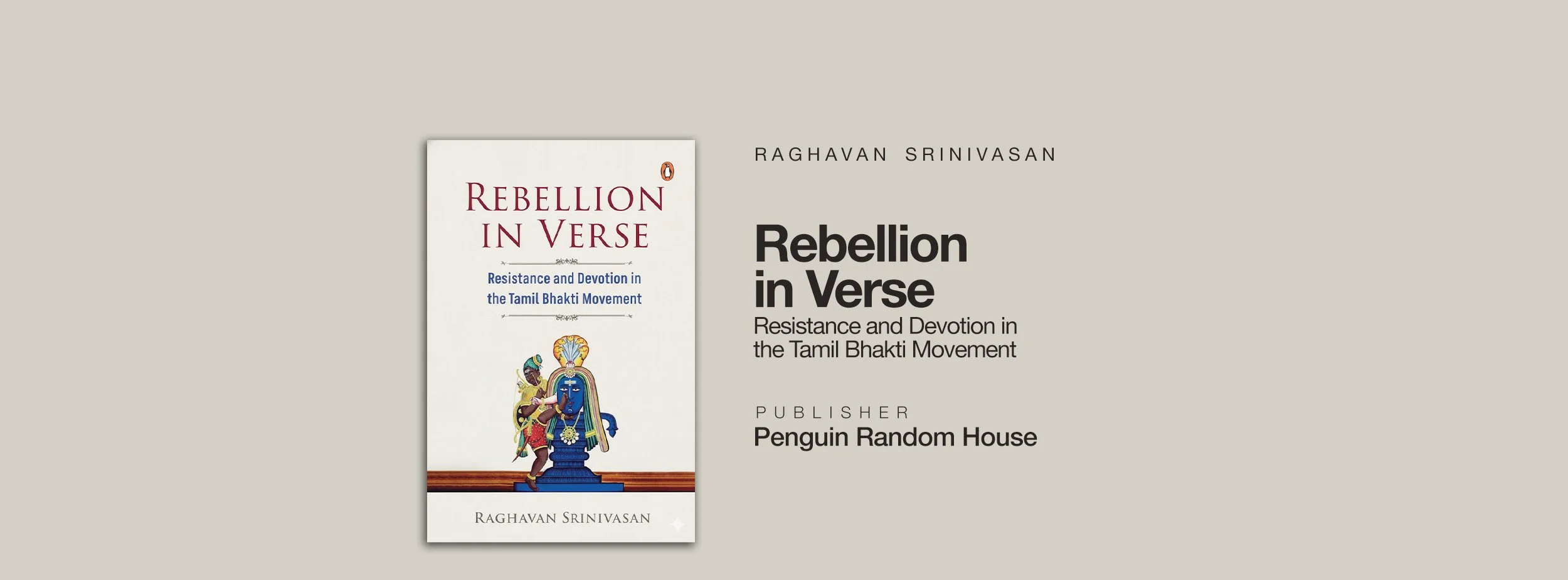

In all probability, this book wouldn’t be something that I would have picked up randomly off a bookshelf. I tend to lean more towards Japanese crime and mystery these days, more so than other crime thrillers — but then I am glad that I did find my way to Raghavan Srinivasan’s Rebellion in Verse.
Srinivasan focuses on the revolutionary nature of Bhakti poetry in medieval Tamil Nadu. The saints—Nayanars and Alvars—composed verses in Tamil, not Sanskrit. This was radical. Sanskrit was the language of the elite. Tamil was the people’s tongue. And thus devotion was democratised, challenging the orthodox establishment of the ‘other’ who had arrived with their own customs, rules, and baggage.
The book traces how these poet-saints rejected ritual complexity. They embraced direct communion with the divine. No intermediaries. No elaborate ceremonies. Just raw, emotional devotion.
Srinivasan analyses several key figures right at the beginning of the book. Karaikkal Ammaiyar, the fearsome woman saint; Appar, who converted from Jainism; Nammalvar, whose mystical visions still resonate with the local popualce. Each poet brought something unique. Each challenged societal norms in their own way.
And then, the Bhakti movement was more than just religious reform. It was social rebellion. Srinivasan makes this clear throughout.
Caste didn’t matter to these saints. Outcasts could be devotees. Women could compose sacred verses. Economic status meant nothing before the divine. This was heresy to the Brahminical order.
The author goes on to repeatedly show how Bhakti poetsry attacked hypocrisy. The saints mocked meaningless rituals. They questioned caste privilege. They rejected empty knowledge without love. Their verses dripped with contempt for spiritual pretenders. Devotion was not the domain of the very few who supplied themselves credentials based on birth.
Take Appar’s poems. He ridiculed those who performed elaborate pujas but had no compassion. Or Andal, the woman saint who wrote herself into marriage with Vishnu. Her boldness shocked conservatives. Her poetry celebrated female desire as spiritual passion.
Srinivasan doesn’t romanticize this resistance either. He acknowledges its limits. The movement didn’t destroy caste. It didn’t liberate everyone. But it cracked the orthodoxy’s armour. It created space for alternative voices.
And then there is ample focus on the choice of Tamil over Sanskrit, as exercised by the Bhakti saints. This decision carried immense political weight. Sanskrit was controlled knowledge. Only upper castes could access it. By composing in Tamil, the Bhakti saints declared: the divine speaks everyone’s language.
Srinivasan explores how this linguistic rebellion enabled mass participation. Suddenly, devotion wasn’t locked behind scholarly gates. Farmers could sing to Shiva. Weavers could praise Vishnu. The sacred became democratic.
Srinivasan provides strong historical grounding. He situates the Bhakti movement within the political and economic changes of medieval South India. The period saw the decline of Buddhism and Jainism. The rise of powerful temple economies. The consolidation of regional kingdoms. Bhakti emerged in this ferment—part religious revival, part social upheaval.
The author shows how royal patronage shaped the movement. Kings supported Bhakti saints to counter Jain influence. They built grand temples celebrating Bhakti deities. This created contradictions. A people’s movement started becoming institutionalised. Rebellious poetry was absorbed into state religion.
Srinivasan doesn’t resolve these tensions though. He lets them complicate the narrative. The Bhakti movement was never pure resistance or pure devotion. It was both. It was messy. It was human.
Srinivasan writes clearly. Academic rigour doesn’t mean dense prose. He explains complex theological concepts simply. He translates Tamil verses with sensitivity, preserving their emotional punch. The analysis balances respect with critical distance. The author admires the Bhakti saints. He acknowledges their courage. But he doesn’t deify them. He questions their silences. He notes whose voices remained unheard.
The book is well-researched. Extensive footnotes guide deeper exploration. Bibliography includes Tamil sources and English scholarship. Srinivasan engages with contemporary debates about religion, caste, and resistance.
Sadly, at some point the form does feel a bit repetitive. You keep hearing the same stories of the Bhakti saints, the same fulcrum of their stories and objectives. The critique of orthodox Brahmanism appears in multiple sections. Tighter editing would perhaps strengthen the flow a tad better than it’s current version.
But coming away from the mere academia of this published work, the reason why I thoroughly enjoyed reading the book was because, I truthfully believe that this book has arrived at a very crucial moment. Religious fundamentalism is rising across India. Caste violence persists everywhere. Marginalised voices face suppression — be it on religious, caste, or gender lines. If I were to be more precise, there is a religious nationalism at play in the country today. My God is better than yours and if you don’t agree I will kill you. Which is what is quite literally happening. Gods have become weapons in the hands of the addle-minded, while those in power continue pulling at religious strings to further their political causes.
And that is where we need the re-birth of the Bhakti movement once again. That is where Srinivasan reminds us: radical spirituality once challenged power. Devotion once meant resistance. Love once broke boundaries.
The Bhakti saints weren’t perfect revolutionaries. Their movement had contradictions and failures. But they imagined a different world. They created space for dignity across caste lines. They insisted the divine was accessible to all.
This history matters. Not as nostalgia. Not as claiming some golden past. But as evidence that Indian traditions contain resources for justice. That rebellion and devotion can coexist. That poetry can be a weapon against oppression.
Raghavan Srinivasan has written an important book. It makes Bhakti history accessible without dumbing it down. It celebrates the movement’s radical edge while acknowledging its limits.
For readers interested in Indian spirituality, this is essential reading. For those studying social movements, it offers valuable insights. For anyone drawn to poetry’s power, it’s a gift.
The Bhakti saints sang a thousand years ago. Their verses still challenge us. Their devotion still inspires. Their rebellion still matters.
Rebellion in Verse ensures we hear them clearly.