
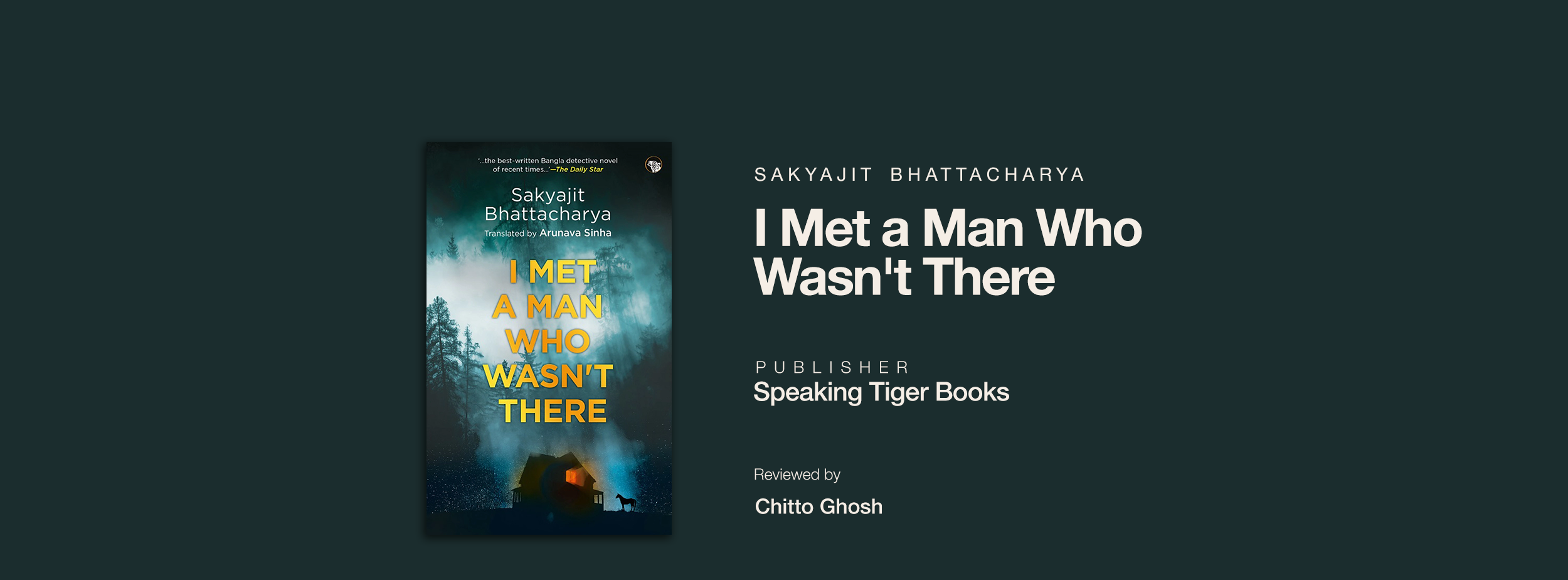

Some murder mysteries are designed as cold intellectual exercises, intricate puzzles of locked rooms and smoking guns. But a rare few transcend the genre to become something far more haunting: an excavation of lost time. These are not merely whodunits; they are literary séances, summoning the spirits of a turbulent past to answer for the silence of the present. In such works, the detective does not just hunt a killer but wrestles with memory itself.
This haunting quality is perfectly encapsulated in the title of the English translation: I Met a Man Who Was Not There. Borrowed from the famous line in Hughes Mearns' poem “Antigonish”—"As I was going up the stair / I met a man who wasn't there"—the title serves as a brilliant thematic key to the novel. While the original Bengali title, Sesh Mrito Pakhi (The Last Dead Bird), evokes the tragic finality of the victim—a "bird" or poet silenced too soon—the English title shifts the focus to the psychological. It suggests a presence that is defined by its absence: the ghost of Amitabha Mitra, the truth that refuses to materialize, and the shifting, Rashomon-like unreliability of memory. It prepares the reader not just for a crime, but for a story about things that are felt but not seen.
In the hills of Darjeeling, the setting of this narrative, the rain is not merely weather; it is a curtain that obscures this past. It washes over the Mall, Jalapahar, and the colonial gravestones of Cart Road, soaking the landscape like the cold, slick skin of a python. It is into this atmospheric gloom—lucidly translated by Arunava Sinha—that the protagonist steps, looking to exhume a ghost from forty-five years ago.
The novel introduces us to Tania (or Tanaya), a crime scribe for a national newspaper whose name and investigative tenacity resonate with Hergé's Tintin. She is in the professional phase of documenting unresolved cold cases, a journey that brings her to the door of Arun Chowdhury. Once a suspect in the murder of his close friend and budding poet Amitabha Mitra, Arun is now a reclusive, famous detective novelist living in a villa steeped in the serene, yet haunting, silence of the hills.
The premise is a classic setup for a locked-room mystery, yet Bhattacharya quickly elevates the text beyond a simple procedural. The narrative structure is a "novel within a novel," running along dual timelines: the immediate, investigative present and the turbulent, incendiary 1970s. The latter is not just a backdrop but a living, breathing entity. The 1970s in Bengal was a time of Naxalite uprisings, the Bangladesh Liberation War, and radical shifts in artistic consciousness. Bhattacharya captures this ethos with the precision of a historian and the heart of a poet.
Indeed, poetry is the lifeblood of this mystery. The author operates on the profound philosophical assertion that the beauty of mystery lies in hesitation and chaos—much like poetry itself. As one character suggests, the joy of deciphering a difficult poem is no less than the thrill of identifying a murderer. The narrative is dense with the literary fabric of the era, referencing poets like Prasun Bandyopadhyay, Ranjit Das, and Krishna Basu, and exploring the "Little Magazine" culture that defined Bengali intellectualism.
However, this strength is also the novel's heaviest burden. At times, the text feels weighed down by its own intellectual adulation. The literary references, while providing an "intellectual edge," occasionally pile up as grand peripheries or ornamentation, threatening to overshadow the central spine of the murder mystery. Yet, for the reader willing to engage with it, this critique of Bengali literature adds a layer of psychodrama that is rare in the genre. It moves the story to the borderline of serious literature, grappling with the cynical reality that "human life is cheap"—a sentiment that chills the spine more than the murder itself.
Arunava Sinha's translation is commendable, preserving the petrichor of the original Bengali while making the complex shifts in perspective accessible to an English readership. Fans of Anthony Horowitz's Magpie Murders or Riley Sager's Home Before Dark will recognize the meta-fictional scaffolding here. But I Met a Man Who Was Not There is distinctly Indian in its soul. It navigates the darkness of a lost generation, ultimately revealing that the true investigation was not just into a death, but into the memory of a time when poetry and violence walked hand in hand through the mist of Darjeeling.
Chitto Ghosh, a former ad professional, is the Editor and Creative Director of Contemporary Tea Time, a Kolkata-based trade quarterly.