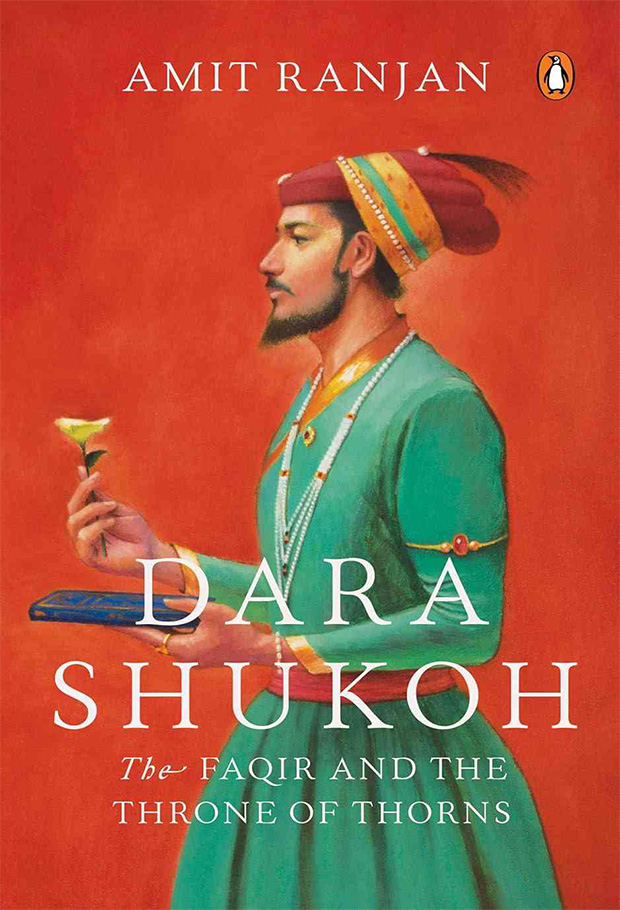
Every now and then we come to a crossroads regarding our collective destinies. What could have been? It is a question that has plagued mankind from the beginning of time. What if the asteroid that cleared out the dinosaurs had never collided with planet Earth, where would we all be? What if Archduke Franz Ferdinand had not been assassinated — would there be no World Wars? What if the Battle of Britain had gone the other way — would we be speaking German today?
History is replete with such what-ifs.
And closer to home, the Indian subcontinent also came face-to-face with such a scenario. What if Shahjahan had been succeeded by the son he wanted to leave his empire to and not the one who killed and marauded his way to the throne? What if Dara Shukoh, the eldest son of Emperor Shahjahan, had found his way to the Peacock Throne instead of Aurangzeb?
While we can never perhaps put this question to rest, considering the open-ended nature of time and destiny, Amit Ranjan's spectacularly researched and novel approach to his Dara Shukoh: The Faqir and the Throne of Thorns does indeed work towards providing us with some amount of succor in reaching some suitable conclusion. At least personally.
This book isn't written in the usual historical longform prose that we associate with such subject matters and such formats. Instead, every chapter invokes the words of the great Leonard Cohen, bringing into perspective the vision of the Prince-who-could-have-been-King.
And what a King he really could have been. A bridge between two religions, between two bands of people, an Emperor of the people — and yet one of them at the same time. Dara Shukoh's ascendancy could have finally united the teeming populace of the vast Mughal Empire, and perhaps also reduced rivalries and animosity between the kingdoms of the subcontinent. A patient listener, a bard, a prophet — and whenever required, an able soldier and commander of his legions. A man conflicted with his imperfections is often the one most perfect to be a leader of men.
Amit Ranjan chooses a non-linear format to tell us the story of this great Prince. After all, the story of Dara Shukoh isn't unknown to us. Or rather, the story of Aurangzeb's blood lust leading up to conquering the throne for himself isn't unknown to us. Oftentimes Dara Shukoh has merely been smuggled into Aurangzeb's story as a footnote. But Amit Ranjan's detailed research has finally set the record straight on that aspect. We finally get to see Dara Shukoh for who he was — and that was everything Aurangzeb was not.
Ranjan also doesn't spare his research only on Dara Shukoh, but instead brings forth several of the supporting characters in this Mughal game of thrones. It paints a rather complete picture of everything that went together in re-arranging the path of succession of the Mughal throne and how it doctored the fate of the empire.
Dara Shukoh eventually comes across as a man we would perhaps all have liked to know. A friend we would cherish. A man like him was a rare find, and it is perhaps one of history's greatest tragedies that his life was cut short without any fanfare or without forcing a greater outcome than what was otherwise indicated in his lifetime.
This is a beautiful book — both in the way in which it is written and from what we learn. Which is really all there is to be a really, really good book.
Get your copy immediately. We owe that much to Dara Shukoh — the Prince-who-should-have-been-King.