Euphoria often defies rationale.
The wave of celebration embraces within its folds those that were meant to be celebrated and often those too which were ought to be decried.
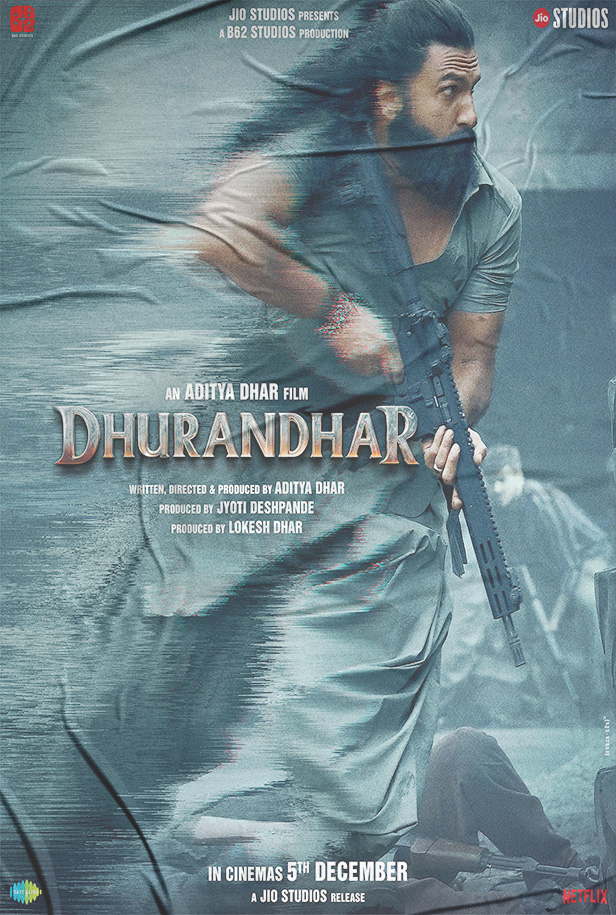
The Dhurandhar duo of 1 and 2 unwittingly swerves between these two poles. Yes. And let's see how.
Drohkaal (1994), a film by Govind Nihlani, dealt with the issue of terrorism. It was one of the first in this genre that depicted the idea of Indian forces infiltrating a terrorist group through undercover officers. One officer gradually wins the trust and respect of the terrorist group including the commander and becomes the leader. There too, the undercover officer turned leader had to kill his close aide, through mutual consent, as his own identity would have been revealed otherwise. The film had a stellar cast of that time featuring the likes of Naseeruddin Shah, Om Puri, Ashish Vidyarthi, Mita Vashisht, Kitu Gidwani, Milind Gunaji, Annu Kapoor and many others. Manoj Bajpayee made his debut in this film with a very short one-minute role. His Bandit Queen with Shekhar Kapoor was released after Drohkaal.
19 years later, in 2013, came D-Day, directed by Nikhil Advani featuring the cast of Rishi Kapoor, Irrfan Khan, Arjun Rampal, Shruti Haasan, Huma Qureshi, Imran Hasnee and others. For the first time a mainstream Bollywood cinema was based on the plot of how Indian Intelligence Agency operatives worked undercover.
In 2017, came Naam Shabana, a film directed by Shivam Nair and produced by Neeraj Pandey. This was the first film in this genre that meticulously detailed out how a prospective Agent is tracked and recruited by the Intelligence Agencies. Taapsee Pannu was the recruit, the much talented Veerendra Saxena (mostly seen in character roles as per Indian cinema lingo) was handling her recruitment, and Manoj Bajpayee was the Agency boss. This film was a sequel to Baby (2015).
Dhurandhar's core plot thus fails to standout as being unblemished by references of being inspired.
These two decades from Drohkaal to D-Day to Baby and Naam Shabana witnessed a major shift in the kind of films that were being made in mainstream Bollywood. In its time, Drohkaal was not a mainstream cinema. It was the age of romanticism in mainstream Bollywood and the hero (that's what the lead man was called) would still prefer to raise his 'dhai kilo ka haath' (Damini, 1993) to put an end to all conflict, even though professionally he could be a lawyer.
D-Day, Baby and Naam Shabnam were among the first well researched mainstream Bollywood cinema that had Indian Intelligence Agency operations as its core plot. These three films definitely brought about the watershed of realism in this genre of films in mainstream hindi cinema.
And more followed with the onslaught of web series on OTT platforms. Family Man and Special Ops definitely being the biggest two franchisees in this genre of Indian spy thrillers.
The audience of these spy web series are an eclectic mix of non-mainstream (those who prefer meticulously crafted content) as well as mainstream (those who prefer wholesome entertainment).
Dhurandhar 1 & 2 aspired to cater to both these audiences, but in the format of a Bollywood film.
So, Dhurandhar 1 had all the ingredients of a great narrative with references to real events, from Kandahar to 26/11 to implicit similarities with Ajit Doval, India's National Security Advisor. The plot was deftly revealed through measured performances of each cast however short or elaborate might be their screen time. The audience was kept guessing. And the climax was gripping. The real life references of events and individuals kept the content relevant and the audience engaged. The cinema craft was also better than what mainstream Bollywood cinema generally offers, on most counts.
Dhurandhar 2 actually had nothing new to show as far as the core plot is concerned, it had only new events to showcase, be it demonetisation or Dawood or the backstory of the protagonist.
The audience for the spy genre had matured in India after being fed with regular diets of Family Man and Special Ops which were large in scale, portraying operations across Central Asia to Middle East to Europe to Srilanka to Tamil Nadu to Nagaland, had meticulously crafted narratives and above excellence acting. Yet, these series were realistic. The audience could easily identify with the characters of these web series as human beings and not stars with halo effect.
This connect with realism got amiss in Dhurandhar 2 as it gradually swerved to being a one-man-army movie. Ranveer Singh was made to overshadow the film in terms of the screen time allocated to him, and not by virtue of his acting prowess alone — the century old pitfall of mainstream hindi cinema, where the protagonist becomes bigger than the story, by screentime and not by craft. Hamza, the character, got overshadowed by the actor. Ranveer Singh performing the same scenes as Akshay Khanna when he was felicitated by the Baloch looked miserable, given the kind of acclaim the latter had received.
The build-up to climax scenes where the Baloch attack Major Iqbal's (Arjun Rampal) den, looked like a forced war being filmed in a congested bylane. As the building was being razed through explosions the false walls and ceilings were crying out for attention. The end of Major Iqbal at the hands of Hamza was depicted in classical style of one-upmanship between the hero and the villain as in the lore of Bollywood cinema. Similarly, in classical Bollywood style the hero was all bruised and bleeding after being tortured in captivity by the Pakistani General (Raj Zutshi) but only in the face and arms, he had a clean palm when he opened them.
More than the film, it is the overall narrative of unmasking Pakistan and the cinematic demystifying of the real life Ajit Doval, that has seemed to have struck a greater chord with the Indian population. The euphoria and celebration are more towards that end.
What stands out most in the film is the superlative casting ensemble curated by the Casting Director Mukesh Chhabra and the immense faith reposed in him by Director Aditya Dhar.
Of course, the casting of Rakesh Bedi as Jameel Jamali is the talk of the country. In a world where people are typecast onscreen and in real life, Rakesh Bedi's portrayal gives a fresh reason to smile and dream again, for the innumerable underdogs who bear the yoke of being typecast. One can see the characters of Raja (Yeh Jo Hai Zindagi, 1984) and Dilruba Ji (Shrimaan Shrimati, 1994) coming a full circle with Jameel Jamali and taking a bow.
Similarly, the gradual morphing of Madhavan from the vivacious Deputy Commandant Preet (Sea Hawks, 1997) to the national heartthrob Maddy (RHTDM, 2001) to the measured and gutsy Danny (Breathe, 2018) and many more, to NSA Ajay Sanyal, minimum screen time, measured performance maximum effect. The audience's cheer in the theatres when NSA Ajay Sanyal is revealed on screen in Dhurandhar 2, as he walks up the stairs smoking his cigarette, to meet the new recruit, Jaskirat, is proof of the character's success.
Of course, there is Arjun Rampal pulling off another fine performance as Major Iqbal. His decision to wear the darker mask in his second film Aankhen (2002) seems to be a propitious call from his future self, as he set the screen ablaze with consistently powerful performances portraying negative characters be it as Mukesh Mehra (Om Shanti Om, 2007), as Ra.One (Ra.One, 2011), as Arun Gawli (Daddy, 2017).
Yes, Akshay Khanna as Rehman Dakait. Well, Akshay Khanna has played a wide range of characters whether as the main protagonist, supporting character or in a negative role across romantics, comedy, thriller and all. What perhaps set him apart in Dhurandhar is his ability to make his character of Rehman Dakait let down his hair and loosen up on screen though portraying an intense negative persona.
However, the portrayal of Sanjay Dutt as SP Chaudhary Aslam had the baggage and aura of being Sanjay Dutt all over, instead of the character. The introductory scene of SP Chaudhary Aslam in the desert reeked of CG animation.
Similarly, the character of Yalina Jamali could have been portrayed by any other fair lady (given the obsession of Indian masses) clinging on to the macho co-star on a super bike, and the adulation bestowed on that person would have been similar to what is being enjoyed by Sara Arjun now.
Of course, there were many more casts which were perfect for the characters they portrayed.
What seems intriguing and satisfying is that while Madhavan's Preet, Maddy and Danny could in due course of time evolve into being NSA Ajay Sanyal, there is no way one could even imagine in one's wildest dream that Rakesh Bedi's Raja and Dilruba Ji could evolve into being Jameel Jamali. And this, is what calls for celebration and euphoria.
Manoj Bajpayee's Bhiku Mhatre had pulled off a similar coup in Satya (1998).
So, does Srikant Tiwari meet Jameel Jamali somewhere in the future!