"All it takes for evil to prevail is for good men to do nothing…"
These words keep coming back to me, particularly when watching fictionalized stories and events in books and movies. Because I'm not opening the real life door here.
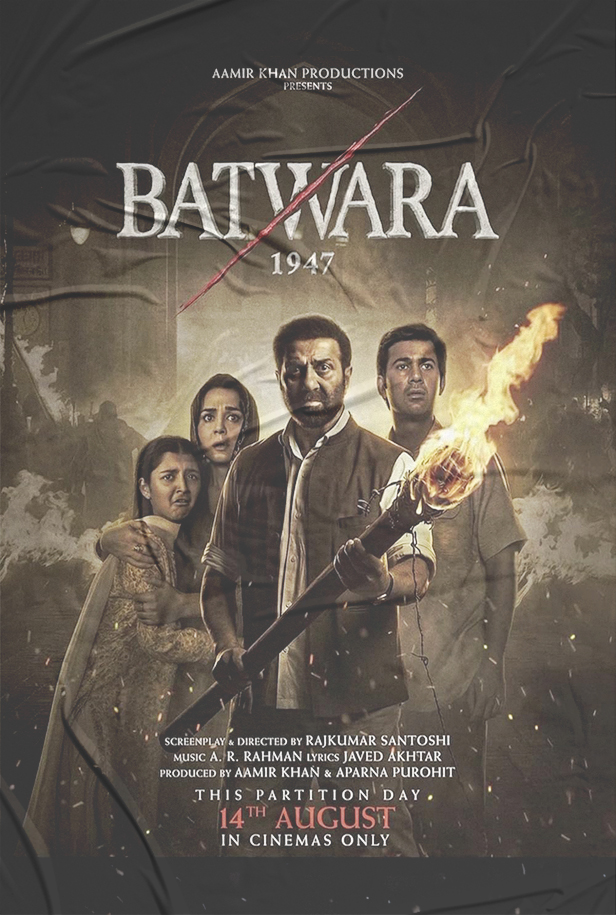
It happened this weekend again — the Independence Day weekend, and on Independence Day itself, when I found myself at the cinema near me watching Rajkumar Santoshi's Batwara 1947. I was privy to the trailer many a time in my attempts at watching some other films like The Odyssey and the current Spiderman film, I had a decent idea of what I was in for — and the bits I didn't know, I just painted in the colours myself.
The term old wine in old bottle quite quickly came to mind. The story progressed the way these movies usually do. Hope, terror, escape, and back to hope again. If you've watched one of these partition movies you've seen them all. Till, as witnessed in the trailer, you are confronted with our Muslim family from Meerut, India, in Lahore, Pakistan, in a house that belonged to a Hindu family — only that the family matriarch was still in there.
This was new. Even if slightly.
The now Pakistani Muslim family are caught unawares. They don't quite know what to do about it. The old lady is adamant that she'd either be leaving with her Hindu son, who should be coming to take her away; or she'd die in that house. There was nothing in between.
And then we're back to the old wine once again — human greed draped under the aegis of religious supremacy. The local goons with nascent political ambitions dive into the fray. The good-meaning recently displaced Muslim family stands their ground, ready to fight for good over evil. And so, it continues for the next couple of hours, and we reach the satisfying conclusion that we are usually all promised in these types of movies.
The actors all do their part, some better than others. Sunny Deol is always a fun watch, particularly when he gets mad over bubbling evil. For someone who's grown up watching her films, it was fun to see Preity Zinta back on the big screen. Shabana Azmi is Shabana Azmi, there's not even a slight drop in her performance. Ali Fazal suits the lost, forlorn poet in a sherwani character to the T (till he turns to sinister evil in a Mirzapur). And Abhimanyu Singh commands every frame he is a part of, that man deserved a lot more flowers than he usually gets.
The period drama was well presented through the set design. While limited in its geography and scope, it was adequate. What was not was A R Rahman's really rubbish score. Not one song was memorable or hummable, and the background score seemed to have been lifted from his lifetime of superlative scores and completely unoriginal. Only when the movie started did I notice Santosh Sivan as the cinematographer. Had I not seen that detail I wouldn't have known otherwise. Disappointing, particularly from a movie that promises that kind of a technical scale.
But the eventual bottom line: was it worth it? Would I recommend? I absolutely would. Considering there's nothing else to watch, considering it was a decent watch without being exceptional, considering you are left wondering whether Sunny Deol would attempt to pull out that defunct handpump in his house and use it as a weapon at some point — yes, totally worth it. To reiterate, if you have nothing else to do, considering there is nothing left to see, go watch Batwara 1947.
C'est la vie.